
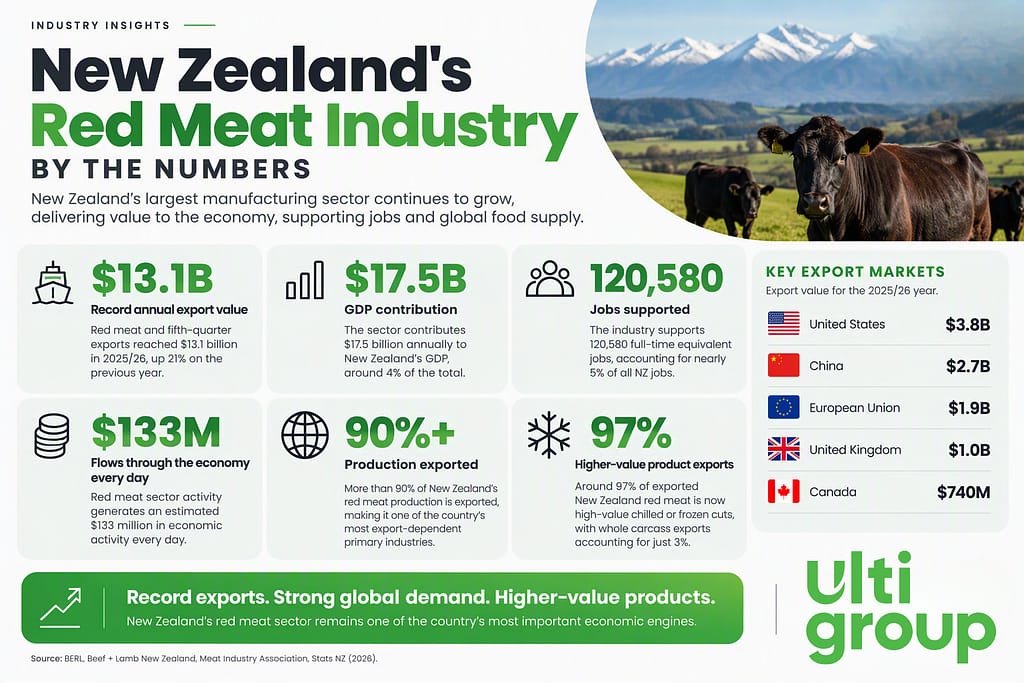
New Zealand’s red meat industry is performing at levels that would have seemed extraordinary just a few years ago. In the 2025/26 financial year, red meat and fifth-quarter exports reached $13.1 billion – a record annual value, up 21 percent on the year before. In August 2026 alone, exports hit $867 million, up 23 percent on the same month last year.
These aren’t just export numbers. Behind them is an industry that supports $17.5 billion in annual GDP contribution, employs the equivalent of 120,580 full-time workers, and sends $133 million flowing through the New Zealand economy every single day.
What follows is a data-backed overview of the industry: its current scale, the forces driving record export returns, the structural shifts underway, and the operational pressures the sector is managing. It’s written for anyone in or connected to the NZ red meat sector.
New Zealand’s red meat sector – at a glance (2025/26)
Source: BERL, commissioned by Beef + Lamb New Zealand and the Meat Industry Association, June 2026
The Scale of New Zealand’s Red Meat Industry
What is New Zealand’s red meat sector?
New Zealand’s red meat sector encompasses the farming, processing, and export of beef, lamb, mutton, and associated co-products (the “fifth quarter”). It includes all livestock production, meat processing, and export activity, together with the supply chains that connect them. More than 90% of production is exported, making it one of New Zealand’s most export-dependent primary industries – and its second-largest merchandise export category.
New Zealand’s red meat sector is one of the country’s most significant economic engines – and it’s often underestimated.
A June 2026 report by economic consultancy BERL, jointly commissioned by Beef + Lamb New Zealand and the Meat Industry Association, put the numbers into sharp focus. In 2025, the sector supported:
- $48.7 billion in total annual expenditure across the New Zealand economy
- $17.5 billion in GDP contribution – representing 4 percent of New Zealand’s total GDP
- 120,580 full-time equivalent jobs – close to 5 percent of all jobs in New Zealand
- $12.8 billion in export earnings annually
That 120,580-job figure is worth pausing on. It’s roughly equal to the population of Dunedin, and more than half of those jobs are generated beyond farms and processing plants – through supply chains, transport, logistics, financial services, and the household spending of workers in the sector.
Every $1 million of direct expenditure in the red meat sector supports approximately five jobs across the wider economy. For Taranaki, Manawatū, Southland, Canterbury, and other red-meat-producing regions, this isn’t just an industry statistic – it’s the economic foundation of entire communities.
New Zealand’s Second-Largest Merchandise Exporter
The Ministry for Primary Industries describes the meat industry as New Zealand’s second-largest merchandise exporter and the country’s largest manufacturing sector. The Meat Industry Association (MIA) reports that the sector generates an average of $3,300 per year in income for every New Zealand household. More than 60 processing plants operate across the country, employing over 25,000 people directly in processing and export roles.
Meat and edible offal represented 13 percent of New Zealand’s total goods exports in the year to December 2025, worth $10.3 billion out of a national total of $80.5 billion.
The sector crossed a significant milestone in October 2025, when Stats NZ confirmed total meat exports had surpassed $10 billion for the first time in a rolling 12-month period.
Regional Contribution
The sector’s economic weight is concentrated in New Zealand’s primary producing and processing regions.
| Region | Red Meat GDP Contribution | FTEs Supported | % of Regional GDP |
|---|---|---|---|
| Otago–Southland | $3.0 billion | 21,722 | 11% |
| Canterbury | $2.9 billion | 19,127 | 5% |
| Taranaki–Manawatū | $2.5 billion | 19,337 | 8% |
| Source: BERL, commissioned by Beef + Lamb New Zealand and the Meat Industry Association, June 2026 | |||
Record Export Performance – and What’s Really Driving It
The headline numbers from 2025/26 are striking. But the more interesting story is how the sector is generating this growth.
The short answer: New Zealand is selling similar volumes of meat and earning significantly more for it.
MIA Chief Executive Nick Beeby described it plainly at the annual Red Meat Sector Conference in Wellington on 29 September 2026: “The more significant movement is in value, reflecting improved returns from international markets.”
Consider the full 2025/26 year:
- Sheepmeat: volume up just 1 percent, but value up 26 percent to $5.2 billion
- Beef: volume essentially unchanged, but value up 21 percent to $5.8 billion
- Fifth quarter (offal and co-products): value up 11 percent to $2.2 billion
The structural reason for this is a deliberate shift that has taken decades. Around 97 percent of exported NZ red meat is now high-value chilled or frozen cuts. Frozen whole carcasses – once the backbone of the trade – now account for just 3 percent of exports. New Zealand has moved away from the commodity end of the market and into value-added product.
Where Is New Zealand Red Meat Going?
Export markets for the full 2025/26 year:
| Market | Value | Year-on-Year Change |
|---|---|---|
| United States | $3.8 billion | +21% |
| China | $2.7 billion | +7% |
| European Union | $1.9 billion | +25% |
| United Kingdom | $1.0 billion | +51% |
| Canada | $740 million | +32% |
The spread across multiple markets is a deliberate strategy, and it’s proving its worth. When one market softens, product moves. When one market surges, New Zealand has the relationships and logistics to respond.
In August 2026 specifically, beef exports to the US reached $155 million (up 30 percent), China sheepmeat rose 46 percent to $71 million, UK sheepmeat jumped 118 precent to $54 million, and Canada grew 55 percent to $18 million.
What’s Fuelling the Growth
Several forces are converging to support NZ’s export performance. Some are structural; others are specific to this moment.
Global Protein Demand
Demand for high-quality protein is growing in key markets. In the United States – New Zealand’s largest export market – demand is being driven by strong consumer interest in nutrient-dense food. Beef + Lamb New Zealand Chair Kate Acland reported at the Out the Gate 2026 conference in Christchurch that between 12 and 20 percent of the American population are now on GLP-1 weight-loss drugs. While these reduce appetite, they increase the need for high-quality protein. “US consumers are being told to prioritise red meat,” Acland said, “and this looks set to remain.”
New Zealand’s grass-fed, natural provenance credentials position the country well to meet this demand.
A Global Beef Supply Shortage
Supply constraints globally are working in New Zealand’s favour. Global beef production fell 2.5 percent in the first quarter of 2026 compared with the same period a year earlier, with Brazil forecast to produce 4 percent less for the full year, the US 3 percent less, and China 2 percent less. New Zealand is one of the few exceptions, with production expected to lift 3 to 4 percent in 2026.
The United States cattle herd is at its smallest in decades following years of drought and high feed costs, meaning American buyers are leaning heavily on imported lean beef – exactly what New Zealand produces.
China’s Quota Changes
In 2026, China introduced a three-year global safeguard quota on beef imports, designed to protect its domestic cattle farmers from foreign competition.
The effect has been significant. Australia breached its quota in mid-June 2026, and its beef exports to China fell 71 percent month-on-month between May and June. Brazil similarly hit its ceiling. New Zealand, with a tariff-free quota of 206,000 tonnes, had filled just 37 percent of it by mid-2026, leaving ample room to capture displaced demand. NZ beef imports into China rose 66 percent year-on-year as buyers actively shifted away from Australian and Brazilian supply.
Rabobank analyst Jen Corkran noted: “New Zealand is relatively well positioned given the diversity of its export portfolio and continued demand across major markets.”
Trade Agreements and Market Access
Free trade agreements are increasingly central to the sector’s strategy. The NZ–UK FTA, NZ–EU FTA, and CPTPP have all supported improved market access, with the UK’s 118 percent sheepmeat surge in August 2026 reflecting improved conditions under the new UK agreement. The recently signed India FTA – once ratified – opens a market that has historically carried a 53 percent tariff on sheepmeat, representing a significant future opportunity.
The Livestock Picture – Fewer Animals, More Value
New Zealand’s red meat sector is navigating a structural shift in its livestock base that would have alarmed the industry a generation ago. But the numbers tell a more nuanced story.
Sheep numbers have fallen dramatically. Stats NZ figures confirm that at 30 June 2025, New Zealand had 23.3 million sheep – down from 42.26 million in 2000–01, a decline of 46 percent over 25 years. The reasons are well-documented: land-use change to dairy and forestry, reduced profitability from wool, and farmer decisions around labour and succession.
Yet the sector is generating record export returns. This is the “doing more with less” dynamic that the MIA’s Nick Beeby highlighted at the September 2026 conference.
Beef cattle numbers are moving in the opposite direction. At 30 June 2025, New Zealand had 3.8 million beef cattle – up 4 percent year-on-year and up 8 percent over the past decade. The Beef + Lamb NZ Stock Survey for the year to June 2026 showed beef cattle rising a further 3.3 percent to 3.96 million, as strong returns encourage more farmers to finish cattle rather than hold sheep.
USDA forecasts suggest NZ cattle slaughter for 2026 at 4.5 million head, with beef production at 720,000 metric tonnes (carcass weight equivalent).
The long-term shift – fewer sheep, more beef, and more value extracted from both – is a financially rational response to global market signals.
Key Players and Industry Structure
New Zealand’s red meat processing sector is shaped by a small number of large processors, several mid-tier operators, and a network of regional plants that form the backbone of rural employment.
The major processors include:
- ANZCO Foods – one of New Zealand’s largest red meat exporters, with an annual turnover of $2.2 billion and nearly 3,000 employees globally. ANZCO processes beef and lamb across both islands and exports to more than 80 countries.
- Alliance Group – a farmer-owned co-operative processing sheep, beef, and deer.
- Silver Fern Farms – a co-operative with a national processing network and strong focus on premium branded products.
The sector’s most significant recent structural development came in late 2026, when ANZCO Foods completed the acquisition of Greenlea Group Limited.
ANZCO completes Greenlea acquisition – September 2026
ANZCO Foods – one of NZ’s largest red meat exporters – completed its $800 million acquisition of Greenlea Group Limited on 30 September 2026. The Commerce Commission cleared the deal in August 2026, finding it unlikely to substantially lessen competition. The combined entity brings together two complementary North Island and South Island beef processing networks, creating a more resilient and diversified processor.
The co-operative model – used by Alliance Group and Silver Fern Farms – gives farmer-shareholders direct alignment with processing returns. The corporate model – used by ANZCO, which is ultimately owned by Japanese multinational Itoham Yonekyu Holdings – provides access to international capital and global marketing capability.
Industry bodies include the Meat Industry Association (MIA), which represents processors and exporters, and Beef + Lamb New Zealand (B+LNZ), which represents farmers. Together, they commission joint research, including the BERL economic impact report, and manage the sector’s engagement with government on regulatory, trade, and environmental policy. The New Zealand Meat Board administers quota allocaion systems for key markets including the EU, US, and UK.
The Workforce – Who Keeps the Industry Running
The red meat sector is one of New Zealand’s most significant manufacturing employers. The BERL report (June 2026) found that of approximately 42,000 people directly employed in the sector, 25 percent (10,578) are Māori and 11 percent (4,788) are Pacific people. Altogether, 56 percent of workers aged 15 to 29 in the sector are Māori or Pacific.
Processing work is often regionally concentrated, physically demanding, and requires consistent, skilled labour – a resource that the sector competes hard to attract and retain. This workforce profile underscores the sector’s significance for regional communities and Māori and Pacific economic participation. The MIA has identified skills development and retention pathways for younger workers as a long-term priority.
The Trends Reshaping Meat Processing
The operational landscape inside New Zealand’s meat processing plants is changing – driven by technology, food safety demands, sustainability pressure, and the need to do more with available labour.
Automation and Robotics
Labour availability is the most persistent operational challenge in meat processing. It’s also the primary force driving investment in automation globally.
A 2025 review published in Trends in Food Science & Technology (SINTEF) found that AI, robotics, and human-robot collaboration are being adopted specifically to address labour shortages amplified by the COVID-19 pandemic and to meet rising food safety standards. Precision cutting is one area advancing quickly. Research published in Frontiers in Robotics and AI (2025) found that 3D vision-based robotic systems now achieve 85 to 92 percent precision in automated meat cutting. New Zealand has its own history here: Silver Fern Farms (then PPCS) partnered with Scott Technology in a joint venture to automate lamb boning room operations – an early and ambitious example of NZ-specific meat processing automation.
Digital traceability is advancing alongside physical automation. Real-time IoT monitoring, blockchain-based supply chain transparency, and AI-driven production optimisation are being adopted across global meat processing operations. Premium international buyers are increasingly expecting this level of supply chain transparency as standard. Automation and facility integration in temperature-controlled processing are directly connected — as plants become more automated, the infrastructure supporting them needs to perform to the same standard.
Energy and Sustainability
Energy is a significant cost in meat processing, and it’s an area under growing pressure from both economics and environmental expectations.
Based on data from EECA energy audits across New Zealand abattoirs, refrigeration compressors account for approximately 50 percent of electrical energy use in a typical meat processing facility. Thermal energy use is dominated by rendering (35 percent) and boiler inefficiencies (25 percent).
About 40 percent of meat processing costs are linked to refrigeration and cold storage, making efficiency in this area vital for profitability and product quality.
– Cold Storage Subject Matter Expert, Ulti Group
For facilities managers and operations teams, the practical reality is that every inefficiency in a cold chain – a door that doesn’t seal properly, a poorly specified blast freezer, a refrigeration system working overtime to compensate for air infiltration – has a direct cost that compounds over time. A door that doesn’t seal properly, a poorly specified blast freezer, or a refrigeration system working overtime to compensate for air infiltration – each carries a price that shows up in energy bills, maintenance budgets, and product integrity. How door systems affect refrigeration costs and energy efficiency is a practical topic for any operations team running a temperature-controlled processing environment.
Decarbonisation strategies being explored in NZ meat processing include heat pump adoption to replace fossil fuel hot water systems, biogas capture from wastewater, heat recovery systems, and low-water sterilisation technology. Globally, biogas plants are now standard in Australian and European processing facilities. New Zealand is still in the early stages of this transition.
Sustainability and Market Access
International buyers increasingly expect evidence of sustainable practices. Methane and nitrous oxide emissions from livestock remain a live policy issue in New Zealand, with the sector having successfully advocated for agriculture to remain outside the Emissions Trading Scheme while pushing for incentive-based approaches to emissions reduction.
New Zealand’s grass-fed, low-intervention production systems are a genuine differentiator in premium markets. Maintaining those credentials as global food standards evolve is an ongoing strategic priority. Facilities investing in temperature-controlled environments and cold chain integrity are also contributing to product quality and food safety performance — both of which matter to international buyers.
Food Safety and Compliance: What NZ Meat Processors Are Required to Meet
New Zealand red meat is exported to more than 110 countries. Maintaining that access requires meeting the domestic standards of each of those markets – and the regulatory framework governing how NZ processors operate is comprehensive.
The Regulatory Framework
The Animal Products Act 1999 (APA) is the foundation of New Zealand’s food safety system for meat processing. It establishes a risk management framework requiring all animal products to be “fit for intended purpose” and governs everything from slaughter and processing through to labelling and export documentation.
Under the APA, all processors exporting animal products must:
- Be registered with the Ministry for Primary Industries (MPI)
- Operate under an approved Risk Management Programme (RMP)
- Meet Overseas Market Access Requirements (OMARs) for each destination country
- Obtain official export assurances (certificates) through MPI’s export certification system
Exporting animal products without the appropriate MPI certification is a criminal offence under the Act, with penalties including fines up to $500,000 and imprisonment for up to five years.
In April 2026, MPI transitioned its export certification system to a new MPI Trade Certification platform, replacing the legacy AP E-cert system. This affects how processors and exporters submit and manage export certificate requests.
The MIA describes the standard NZ red meat is expected to reach as: “produced to some of the world’s highest standards not only for food safety and quality but animal welfare.”
What This Means on the Plant Floor
Food safety and hygiene compliance in a meat processing environment isn’t just about paperwork and certification. It’s built into how a facility is designed, maintained, and operated every day. This includes:
- Hygiene-compliant materials and surfaces that can withstand high-pressure washdowns
- Temperature separation between processing zones, blast freezing areas, and ambient environments
- Pest prevention at every entry point
- Controlled airflow to manage contamination risk
- Equipment and doors that can be sanitised quickly and completely between production runs
The facilities that export successfully – and maintain their overseas market access – are the ones where hygiene and temperature control are treated as operational disciplines, not just audit checkboxes. Our work in food processing facilities across New Zealand includes temperature-controlled environments, hygiene-compliant door systems, and cold chain infrastructure built to meet these operational demands. Ulti Group has also developed high-speed door systems designed for hygiene-controlled environments, supporting food processors who need to manage airflow, contamination risk, and throughput at the same time.
Operational Challenges – What the Industry Is Managing Right Now
Strong export returns don’t mean the sector is without pressure. Several operational challenges are running alongside the growth story.
Labour supply remains the most consistent concern. Meat processing is physically demanding, seasonally variable work, located predominantly in regional centres. Attracting and retaining workers – particularly as competition for labour intensifies across primary industries – is a structural challenge with no simple solution.
Energy costs are significant and rising. With refrigeration compressors alone accounting for around half of electrical energy use in a typical plant, and hot water systems driving the majority of thermal energy costs, energy management is a direct profitability lever.
Infrastructure age and upgrade cycles are relevant across much of the industry. Many New Zealand processing plants have been operating for decades, and the capital investment required to modernise equipment, upgrade cold chain infrastructure, and integrate automation technology is substantial.
Exchange rate exposure is a perennial factor for an export-dependent industry. A stronger New Zealand dollar directly reduces the NZD value of offshore earnings.
Geopolitical and trade uncertainty is the wildcard. US tariff policy has been unpredictable, and while NZ beef has absorbed the 15 percent US tariff in place, B+LNZ estimates that tariff could strip close to $500 million annually from sector earnings if conditions change. The India FTA, while promising, has yet to be ratified. And China’s safeguard quota – currently advantaging NZ – is a policy setting, not a permanent structural shift.
As MIA’s Nick Beeby noted at the September 2026 conference: “One month’s data should be viewed in context, given the global volatility and cost-of-living pressures that may push some consumers towards lower-value proteins.”
The sector’s strength is real, and so is the caution.
The Road Ahead – Outlook for NZ Red Meat Processing
The medium-term outlook for New Zealand’s red meat sector is positive, with some significant headwinds to navigate.
MPI’s Situation and Outlook for Primary Industries (SOPI) report (June 2026) forecast red meat and wool export revenue to reach $14.1 billion in the year to 30 June 2026 – a 14 percent increase – before rising a further 1 percent to $14.3 billion in 2026/27. Beef + Lamb NZ forecasts combined beef, lamb, mutton, and wool receipts of approximately $12.6 billion across 2026–27.
Beef + Lamb New Zealand has set an ambitious target: growing the sector’s export value to $23 billion by 2035.
Getting there will require:
- Continued value-add focus – moving further up the processing chain, away from commodity cuts and towards premium, branded, and further-processed products
- Productivity gains on-farm and in processing – the BERL report explicitly named this as a priority: “the sector can unlock significant additional value for New Zealand by continuing to grow our productivity on-farm and in processing”
- Technology investment – in automation, traceability, energy efficiency, and cold chain performance
- Market diversification – maintaining the multi-market spread that insulates the sector from single-market risk
- Sustained trade access – protecting and extending FTA-based access across the US, EU, UK, China, and emerging markets
At a facility level, this means processors face a clear investment imperative. Plants that were built for a different era of the trade – based on volume throughput of commodity product – are not the same facilities that will generate premium returns in a market demanding provenance, traceability, food safety integrity, and energy efficiency. The facilities that will perform well over the next decade are those being designed and upgraded with that future in mind.
Conclusion
New Zealand’s red meat industry is in a period of genuine strength. The numbers – $13.1 billion in annual export value, $17.5 billion in GDP contribution, 120,580 jobs, $133 million flowing through the economy every day – reflect an industry that has systematically improved the quality and value of what it produces over decades.
The current export boom is being driven by a combination of global supply tightness, strong premium protein demand, smart trade positioning, and years of disciplined focus on extracting more value from every animal processed. The shift from frozen carcasses to high-value chilled and frozen cuts (97 percent of exports now) is the clearest evidence of that.
The sector is operating in a complex, fast-moving global environment. Labour, energy, infrastructure, geopolitics, and consumer demand patterns are all in motion at once. The processors and facilities teams managing those pressures day to day are the ones who understand best that strong export returns at the border start with rigorous operational performance on the plant floor.
Ulti Group has worked alongside New Zealand’s food processing and cold storage operations for more than 30 years, from loading docks to blast freezer rooms. Facility performance connects directly to product integrity, food safety compliance, and the export credentials that buyers around the world are increasingly scrutinising.
If you’d like to talk about how your facility handles temperature control, hygiene compliance, or cold chain integrity in a growing industry, our team works with food processors across New Zealand.
FAQ Section
What’s the practical difference between chilled and frozen red meat? Chilled product reaches the buyer fresh, without being frozen – typically within 30 to 60 days of processing. It commands a higher price because eating quality is better and it meets the expectations of premium retail and food service buyers. Frozen product can be held and shipped over longer timeframes. NZ’s shift toward chilled and frozen cuts (and away from frozen whole carcasses) is as much a quality upgrade as a processing one.
What’s the difference between the MIA and Beef + Lamb New Zealand? The MIA represents processors, marketers, and exporters. Beef + Lamb NZ represents the farmers who supply the livestock. They work together on shared priorities but advocate separately for their respective members.
Are deer (venison) included in the export figures in this article? No. The figures here cover beef, lamb, mutton, hogget, and fifth-quarter products. Venison is tracked separately by Deer Industry New Zealand.
How does the NZ dollar affect what processors and farmers actually receive? Because more than 90 percent of red meat is exported, earnings arrive is foreign currency – mainly USD, EUR, and GBP. A stronger NZD reduces what those convert back to, which is one reason farm profit is forecast to soften in 2026/27 despite strong global export values.
How does a processor find out what their target export market requires? MPI maintains a searchable database of Overseas Market Access Requirements (OMARs) by country and product. Requirements vary significantly – what clears freely into Australia may need a full veterinary health certificate for China.
Are sheep numbers expected to keep falling? The structural drivers – dairy conversion, forestry, reduced wool returns, and labour intensity – haven’t reversed. Further falls are likely, though the rate may slow if lamb prices remain strong enough to shift farmer decisions back toward sheep.
Where does fifth-quarter product go? Offal goes primarily to Asian markets, where cuts like live, tripe, and tongue are premium products. Hides feed the leather industry. Tallow goes into food manufacturing and industrial use. Blood and bone into fertiliser. NZ’s fifth quarter earned $2.2 billion in 2025/26 – a significant and growing revenue stream for processors.